West Africa cocoa: a real trigger that doesn't fire every time
Cocoa is the El Niño story to watch for 2026-27, and for good reason. West Africa grows two-thirds of the world's beans in one narrow belt, the price hit an all-time $12,931/t in December 2024, and the 2023-24 El Niño overlapped the growing season behind that peak. The obvious inference draws a straight line from the Pacific to the price. Our analysis does not support that line.
The signal is real: El Niño pushes the cocoa belt towards stress. Composite growing-season stress over the El Niño analogue years sits clearly above neutral, and about 75% of the closest analogue years run hotter and drier than average. What varies is the size of the hit. Two recent years, 2015 and 2023, ran well above neutral; quieter El Niño years like 1986 and 1991 sat near it. El Niño reliably raises the odds of a stressed belt; how hard a given year bites is what we can't call in advance. That range is the finding, not a reason to discount the signal.
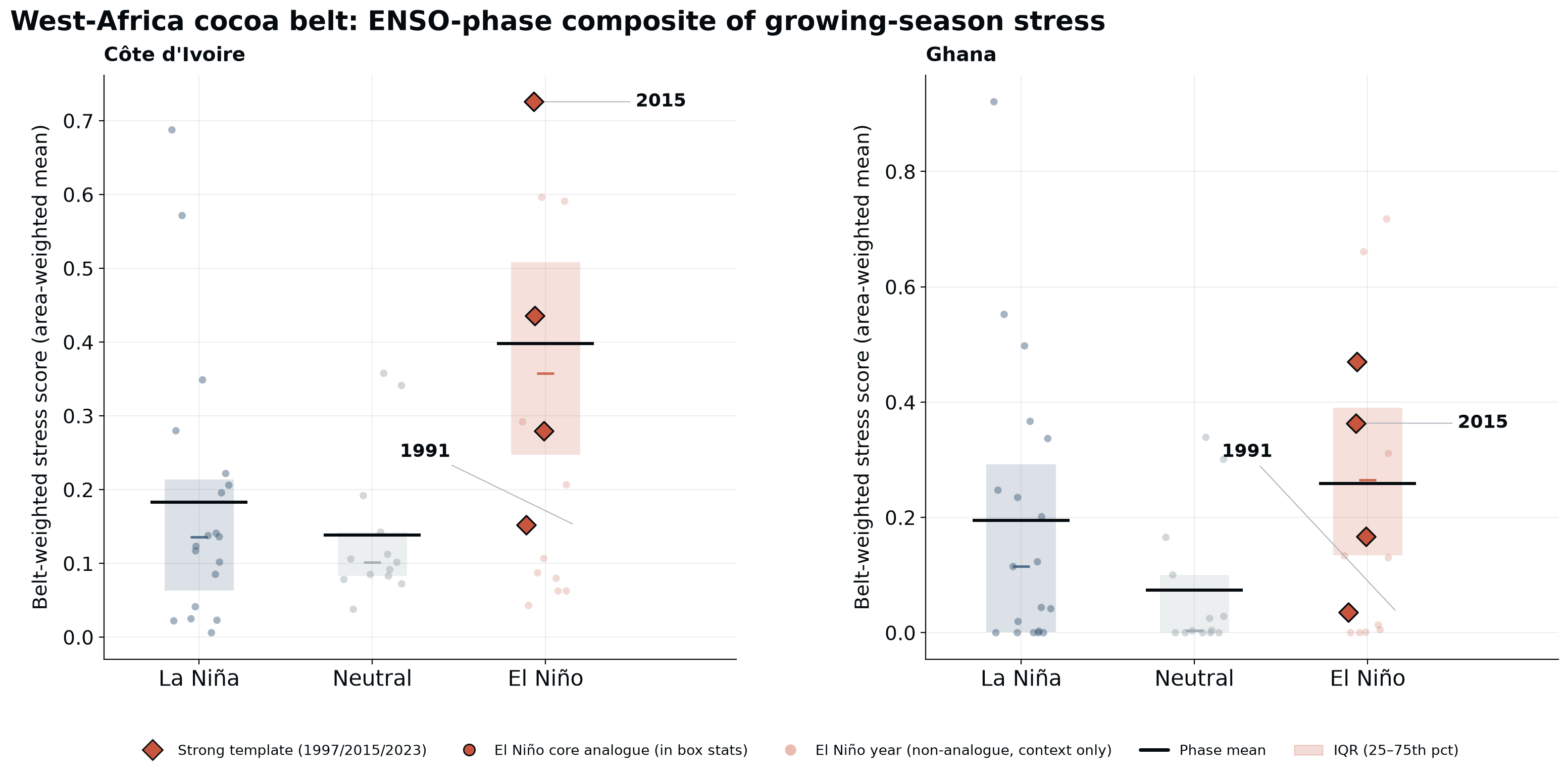
El Niño cocoa-belt stress: the average sits above neutral, with 2015 and 2023 the hardest-hit years. Source: ERA5-derived CIV+GHA cocoa-belt stress, ENSO analogues from analogue_finder. Treefera.
2024 was a two-phase shock, and El Niño lit both halves. West Africa's late-2023 rainfall ran at more than twice the 30-year average, the El-Niño-linked wet phase visible in our own data, and that excess drove a black-pod epidemic, a fungus (Phytophthora) that thrives in the wet. The weather then flipped to drought and heat through 2024, cutting flowering and pod set. So the Pacific struck twice: directly, and through a disease its rain helped create. But the scale of the crisis still needed dry tinder: mealybug-borne swollen-shoot virus (structural, not weather), ageing and under-invested trees, and more than $8bn of speculative length. Across all years, belt weather-stress explains about 1% of Côte d'Ivoire's production variance and 10% of Ghana's, and even that understates 2024, because the disease channel sits outside the index. El Niño was the spark; the fire needed the tinder.
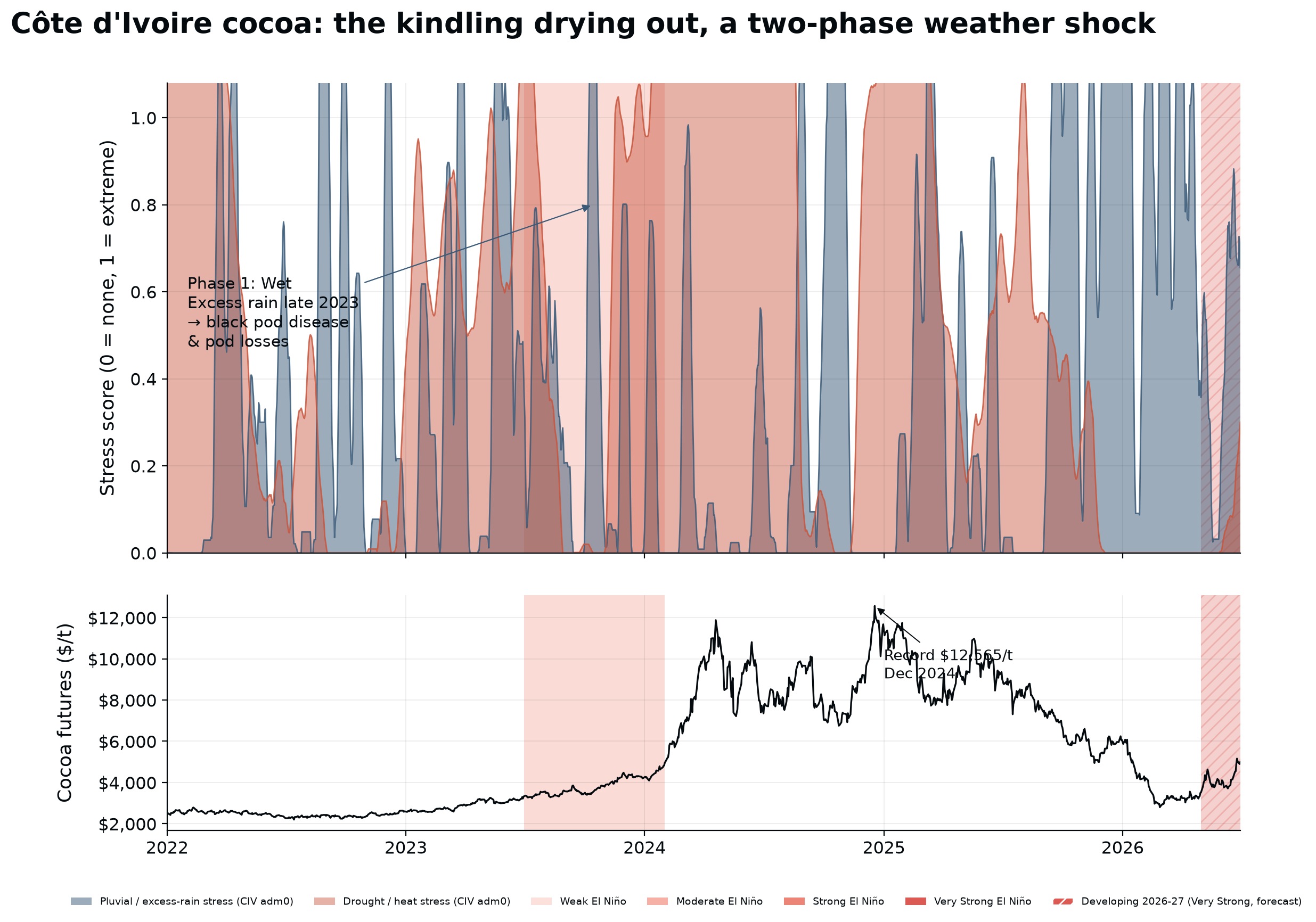
Côte d'Ivoire 2023-24: a wet phase (black pod) flipping to a dry, hot phase (flower loss), the one-two punch. Source: ERA5-derived CIV cocoa-belt drought + pluvial stress. Treefera.
The clincher: a bigger El Niño once produced no price spike at all. The Very Strong 1982-83 event hammered the same belt, and cocoa prices went nowhere, because the market was then in surplus. A weather shock and a price shock are different events; the second needs tight stocks, fragile supply and positioning to line up with the first.
So for 2026-27, El Niño raises the risk of a West African shortfall, and that risk is worth watching at the field edge. The lesson of 2024 is not that El Niño is harmless: it did real damage. It is that El Niño lights the spark, and whether the spark becomes a fire depends on tight stocks, fragile supply and positioning already being in place. Watch the spark. Watch the tinder too.