Coffee: El Niño hits the two beans in opposite directions
El Niño does not move coffee one way. It raises drought risk for Vietnamese robusta and lowers frost risk for Brazilian arabica, so the world's two coffees respond in opposite directions.
Robusta under threat
El Niño's clearest signal on any crop in this report falls on Vietnamese robusta. Vietnam grows nine cups of robusta in ten, almost all in the Central Highlands, and El Niño reliably suppresses that region's dry-season rainfall: across 45 years, the warmer the Pacific, the less the rain, at r = −0.69. An El Niño dry season brings about half the rain of a La Niña one. For a tree that flowers in that window, the drought risk is real and large.
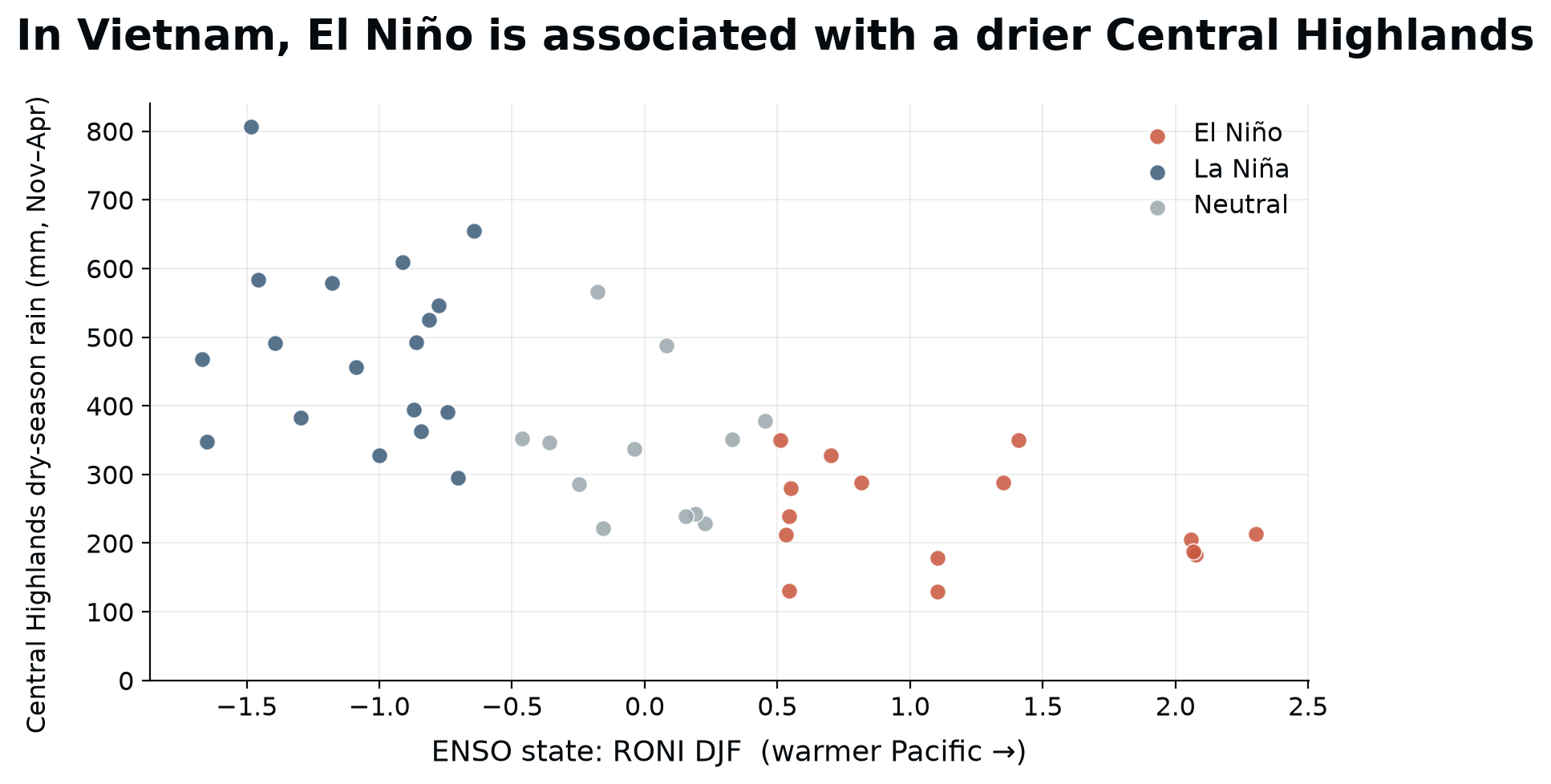
El Niño halves the Central Highlands dry-season rain: the warmer the Pacific, the less the rain (r = −0.69). Source: ERA5 areal indices, NOAA RONI. Treefera.
Irrigation breaks the link between that deficit and national yield. The rainfall signal does not carry through to output (r ≈ +0.15, not significant); under one of the strongest El Niños on record, 2015-16, yield moved by −0.1%. The reason is structural: through the dry season, rain meets only about a quarter of the trees' water demand, and farms pump the rest, much of it from groundwater. That buffer is real but finite: Đắk Lắk's water table is falling and reservoirs ran dry in 2015-16, so a prolonged 2026-27 drought would land on a thinner cushion.
Price depends on more than weather. Across sixty years robusta prices show almost no standalone ENSO signal (r = 0.06): of the six biggest rallies, only 2024 coincides with El Niño, and that year combined drought with depleted stocks. The drought is a genuine upstream risk; it moves price when it meets tight stocks, as in 2024, and not on its own.