Arabica: El Niño is the low-risk phase
Brazil's arabica is the mirror image. Its biggest price driver is frost: the 1975, 1994 and 2021 frosts each roughly doubled the price. Frost is a synoptic cold-air outbreak, largely independent of ENSO; to the extent ENSO modulates it, El Niño tilts southern-Brazil winters milder. In our belt index El Niño is the least frost-prone phase (frost stress 0.019, against 0.024 in neutral and 0.033 in La Niña), and raw ERA5 cold-nights agree.
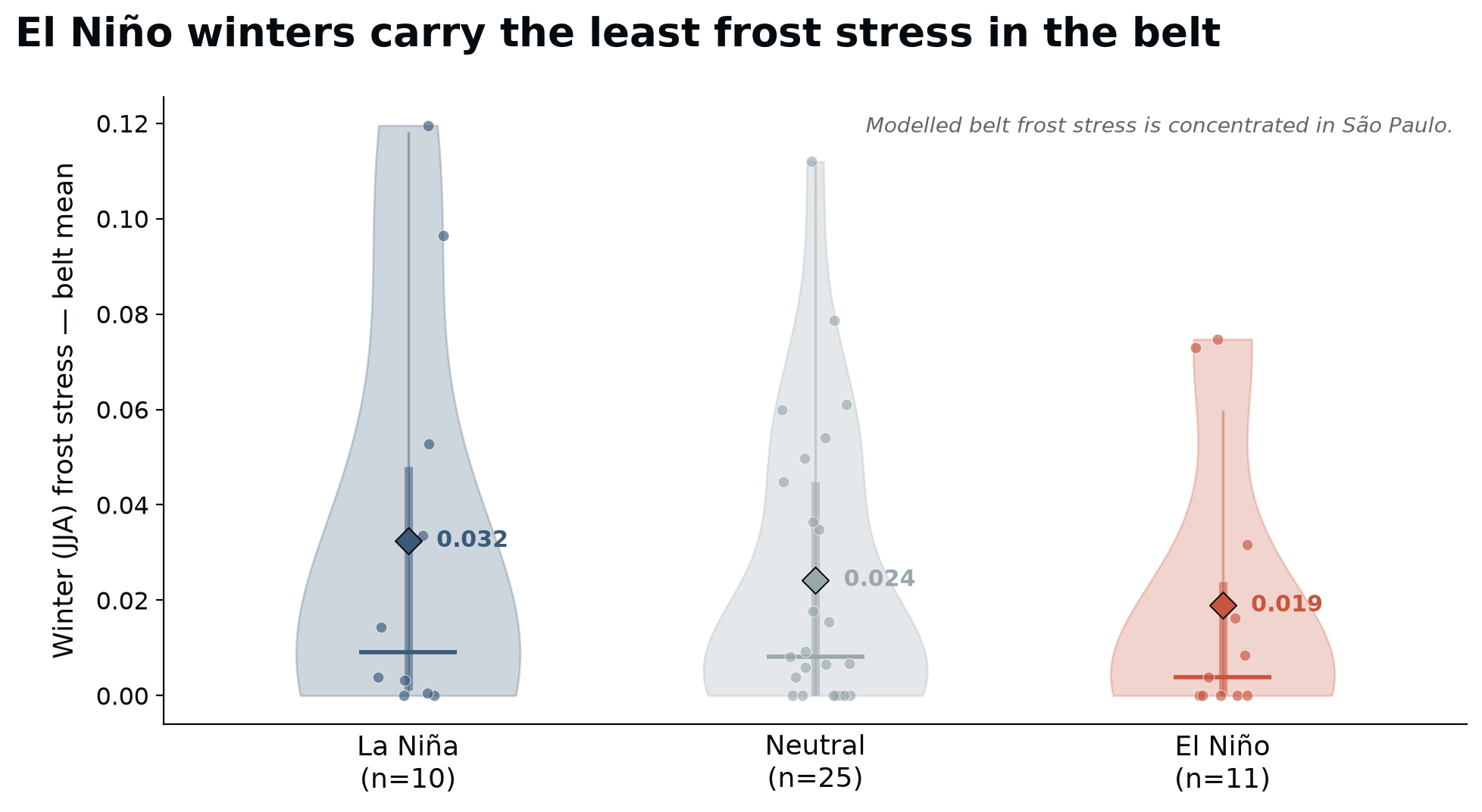
Brazil coffee-belt winter frost stress by ENSO phase: El Niño is the mildest phase. Source: ERA5 tasmin, NOAA RONI. Treefera.
So El Niño, if anything, reduces arabica's dominant risk. The price record agrees: El Niño years sit on the bearish side (median return about −5%), and the rallies everyone remembers, 1977, 1994 and 2021-22, were frost-driven, in La Niña or neutral winters, not El Niño. The 1997 El Niño rally, routinely filed as an ENSO event, was speculative buying into post-frost tight stocks; Brazil's crop was spared.
So, long coffee on an El Niño?
The forecast alone does not justify it. For robusta the drought is real but buffered by irrigation, and it has reached price only once in sixty years. For arabica El Niño reduces frost, the one risk that moves the market, so the phase tilts mildly bearish. On neither bean does an El Niño forecast support a long.