It's the calendar, not the crop
ENSO is a Northern Hemisphere winter phenomenon. Its grip on North American weather builds through autumn, peaks from November to January, and fades by spring. So it lands hard on a crop whose season overlaps that window and barely touches one whose season sits outside it. Two neighbours in the US grain belt fall on opposite sides of that line.
Southern-Plains winter wheat (Texas, Oklahoma, Kansas) is sown in October and fills its grain the following spring, so its whole life overlaps the ENSO peak. El Niño tilts those winters wetter, recharging the soil the crop draws on, and the signal is clean: production tracks the preceding-winter RONI, running about +18% above trend in El Niño years and −4% in La Niña.
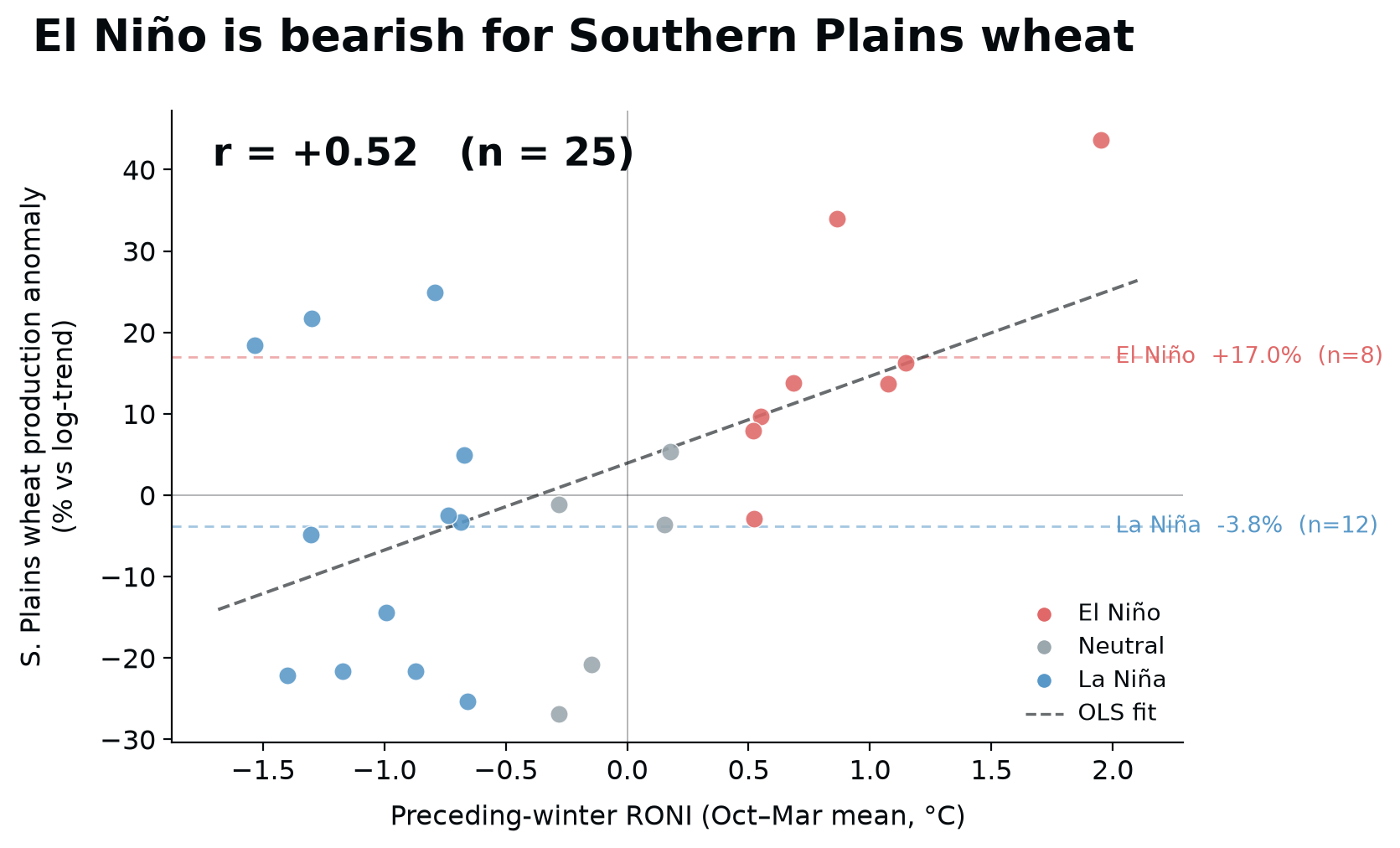
Southern-Plains winter wheat production tracks the preceding-winter RONI (r = +0.54). Source: USDA-NASS (TX/OK/KS), NOAA CPC RONI. Treefera.
Corn is the mirror image. It goes in the ground in May and sets its yield at pollination in mid-July, deep in the summer and months after ENSO has decayed. By the time corn is vulnerable, the El Niño signal has muted.
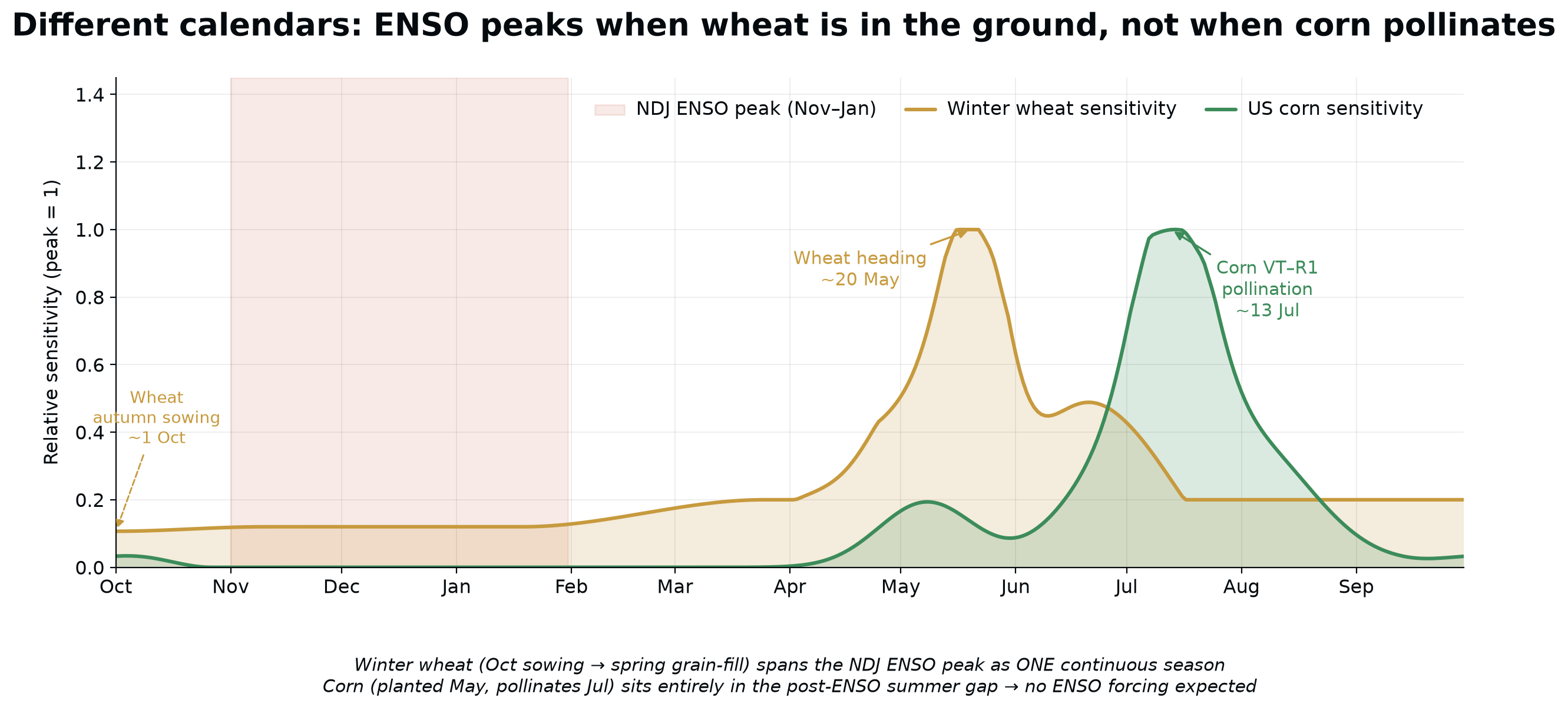
Winter wheat's Oct–Jul season spans the Nov–Jan ENSO peak; corn's July pollination sits in the summer gap. Source: twx-phenoweight presets, NOAA CPC ENSO climatology. Treefera.
Composite the corn belt by ENSO phase and the growing-season stress is flat, the detrended yield response within about an eighth of a standard deviation of zero. That null is structural, not statistical: nothing connects the Pacific's winter peak to corn's mid-July pollination. It is not a weak correlation to dismiss as small-sample noise; it is the absence of a mechanism.
The corn spikes people remember were not El Niño events. The 1988 surge was the great La Niña drought; 2012 was a heat dome NOAA attributes to internal variability rather than the ocean; 2007 was the ethanol mandate. Each is routinely attributed to El Niño, and none was caused by it.
So the disciplined read for 2026: do not expect this El Niño to shock the US corn balance. Where it does reach a US crop, winter wheat, it arrives as relief rather than damage, through a wetter Southern Plains, a better crop and softer prices. The dependable El Niño signal here is the risk it removes, not the one it adds.